Art Cars Explained
From a fruit-covered car in Houston to licensed mutant vehicles in the Nevada desert, the rolling sculpture is a very American folk art.
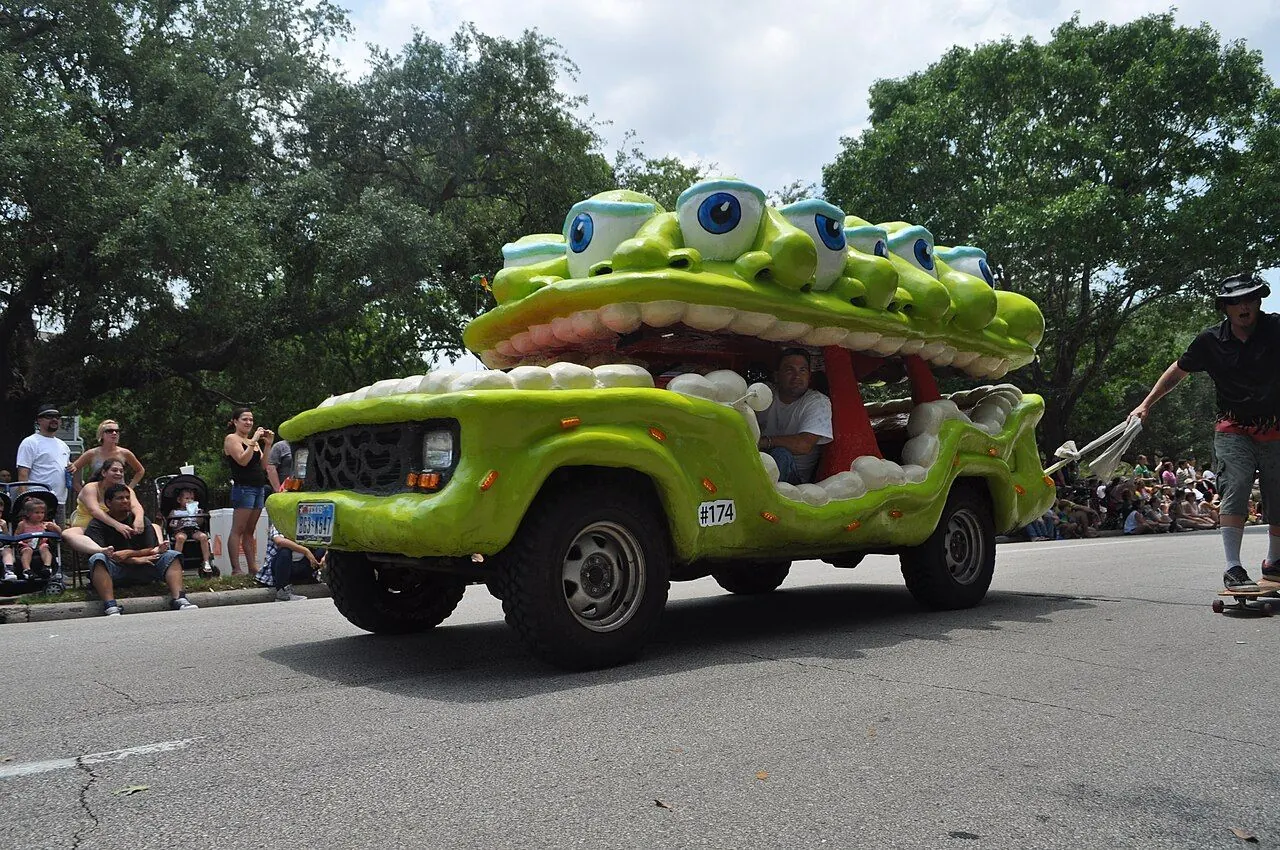
Photo: Alex Brogan / Wikimedia Commons, CC BY-SA 3.0. Illustrative image.
An art car is an ordinary vehicle that its owner has altered to suit their own creative vision, turning it into a moving public artwork without losing its function as a vehicle. The Houston Art Car Parade and Burning Man's mutant vehicles are its best-known showcases.
What Counts as an Art Car
The Houston Art Car Parade defines an art car as "a vehicle whose owner has modified its appearance in a way to suit their own aesthetic, personality, or creative inspiration." Art cars usually begin their lives as an older or used vehicle, and the change can range from cautious to radical. Some creators alter a car "cautiously and tentatively" with temporary materials such as tape or paper, while others reshape the original structure until the vehicle becomes a moving sculpture. The point is not what's under the hood but what happens to the exterior and interior, and the canvas can be a car, truck, van, bus, jeep or golf cart.
In other words, an art car is not simply a custom paint job. It turns a utilitarian form into a moving sculpture or painting, and it still gets driven.
Houston and the Parade Culture
Houston, Texas, is the best-known home of American art car culture. The Houston Art Car Parade is produced by the Orange Show Center for Visionary Art, a nonprofit built around the Orange Show Monument, the handmade environment a Houston postman, Jeff McKissack, began in 1956. Its roots go back to 1984, when Houston artist Jackie Harris transformed a donated car with about $800 worth of paint and plastic fruit, creating the Fruitmobile. An Orange Show "Road Show" of art cars followed in 1986, and the first parade, "Roadside Attractions: The Art Car Parade," debuted in 1988 with 40 vehicles and an estimated crowd of 2,000. The City of Houston now describes it as the largest celebration of its kind in the world, with more than 250 entries and hundreds of thousands of spectators.
Mutant Vehicles and Building Your Own
At Burning Man, art cars are called mutant vehicles, and the rules are strict. A mutant vehicle must be radically, stunningly and safely modified from its base vehicle; vehicles merely stripped to the frame and engine, or with minimal changes or temporary decorations, generally do not qualify. Every mutant vehicle must be inspected and licensed by the event's Department of Mutant Vehicles before it can drive on the playa, drivers need a valid driver's license, and the speed limit in Black Rock City is 5 mph.
On public roads the same logic applies in a different form: an art car is still a registered vehicle, so it has to stay roadworthy under your state's rules. Before adding anything that extends the body or covers windows, mirrors or lights, check with your state's motor vehicle agency and your insurer.
Most builders start the way the Houston parade describes, with an older or used vehicle and materials they can change or remove. Watching a parade, talking to builders and studying how finished cars hold their decorations at speed are the practical first steps. The art car sits between personal vision and the plain need to drive safely, and the best ones manage both.