What Is a Krewe
From Mobile's Cowbellions to Comus, Rex and Bacchus, how private Carnival clubs came to run the parades and balls of the Gulf Coast.
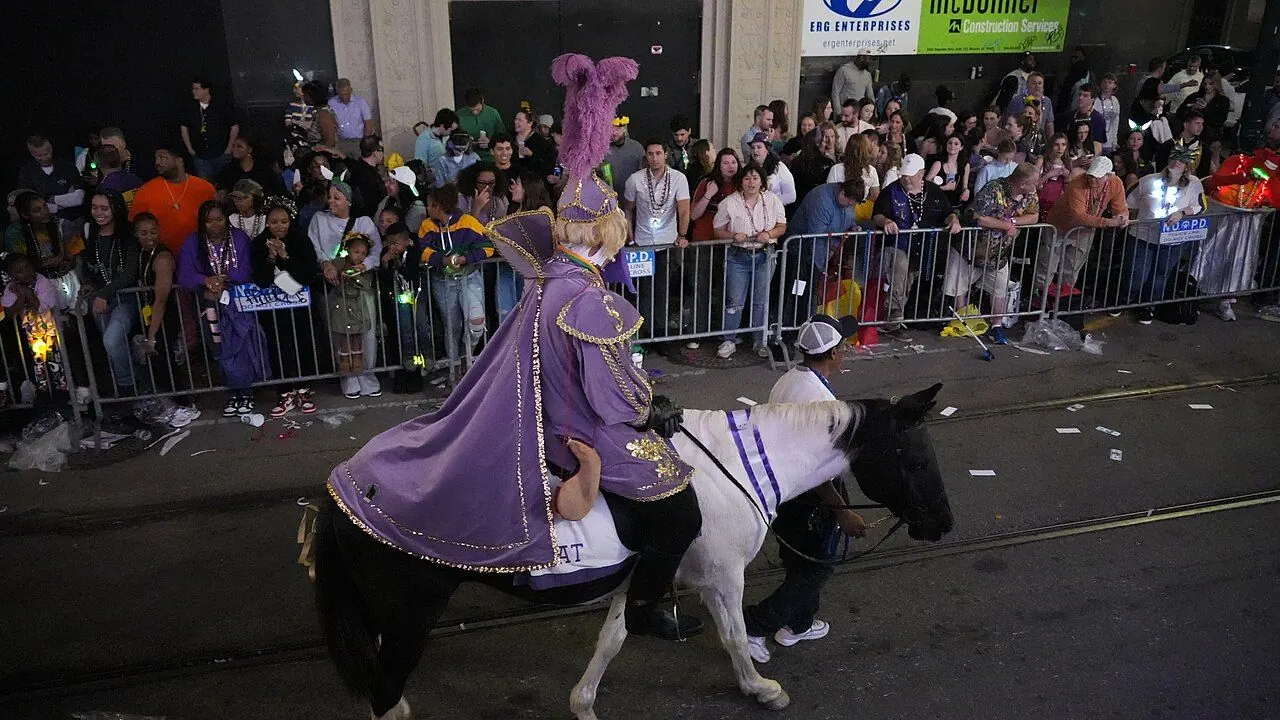
Photo: Miguel Discart / Wikimedia Commons, CC BY-SA 2.0. Illustrative image.
A krewe is a private club that exists to celebrate Carnival: its members stage a parade, a ball, or both during the Mardi Gras season. In New Orleans the word covers every Carnival organization, from century-old secret societies to walking clubs that march through the French Quarter.
Where the word comes from
The Historic New Orleans Collection defines a krewe, simply, as a club or organization that exists to celebrate Carnival. The word has a distinctly New Orleans origin story: according to the city's tourism office, it was first used by the Mistick Krewe of Comus in 1857, the year Comus staged the city's first recorded Mardi Gras parade with themed floats.
Much of the model came from Mobile, Alabama. The Encyclopedia of Alabama traces organized American Mardi Gras to the Cowbellion de Rakin Society, formed on New Year's Eve 1831 when a cotton broker named Michael Krafft and friends paraded through downtown Mobile with rakes and cowbells. By the 1850s several Cowbellion members had moved to New Orleans and carried their parading traditions with them. Mobile still calls its Carnival clubs mystic societies, because their membership was secret, and its floats are known for throwing MoonPies.
Old-line krewes and superkrewes
In the realm of New Orleans' old-line Carnival organizations, krewes like Comus and Rex follow a ceremonial hierarchy with plenty of mystery and pageantry. The captain, described by the Historic New Orleans Collection as in many ways the CEO of the krewe, runs the ball and parade and usually stays masked and anonymous, with Rex's captain the exception. Rex, founded in 1872, parades on Mardi Gras Day, and its leader, Rex, King of Carnival, is chosen from the membership every year. The title is simply Rex, never "King Rex," since rex already means king in Latin. Rex gave Mardi Gras its colors, purple, green and gold, in 1872; the meanings of justice, faith and power were attached in its 1892 parade "Symbolism of Colors." The organization's official song remains "If Ever I Cease to Love."
Superkrewes are the giant modern parades. Bacchus, which first rolled in 1969 with Danny Kaye as its king, set the pattern with huge multi-level floats and celebrity monarchs; Endymion and Orpheus are the other names most often grouped with it, and the state tourism office describes Orpheus as welcoming members from all walks of life. At the other end of the scale are walking krewes, which parade on foot rather than on floats.
Throws and how people join
Throws are the beads and trinkets that float riders toss to the crowd in answer to the cry "Throw me something, mister!" Common throws include beads, doubloons stamped with the krewe's insignia, plastic cups, stuffed animals and small toys.
Joining depends on the krewe. Old-line krewes are private and largely invitation-only, while many newer krewes and walking clubs accept anyone who applies and pays dues. Rules, costs and deadlines are set by each organization, so the krewe's own website is the place to check. Whenever you hear the word in New Orleans, Mobile or anywhere else, it almost certainly refers to the club behind a parade or ball.