Folk vs Outsider Art
Quilts and decoys on one side, private visions on the other, and a lot of shared ground in between that museums rarely keep apart.
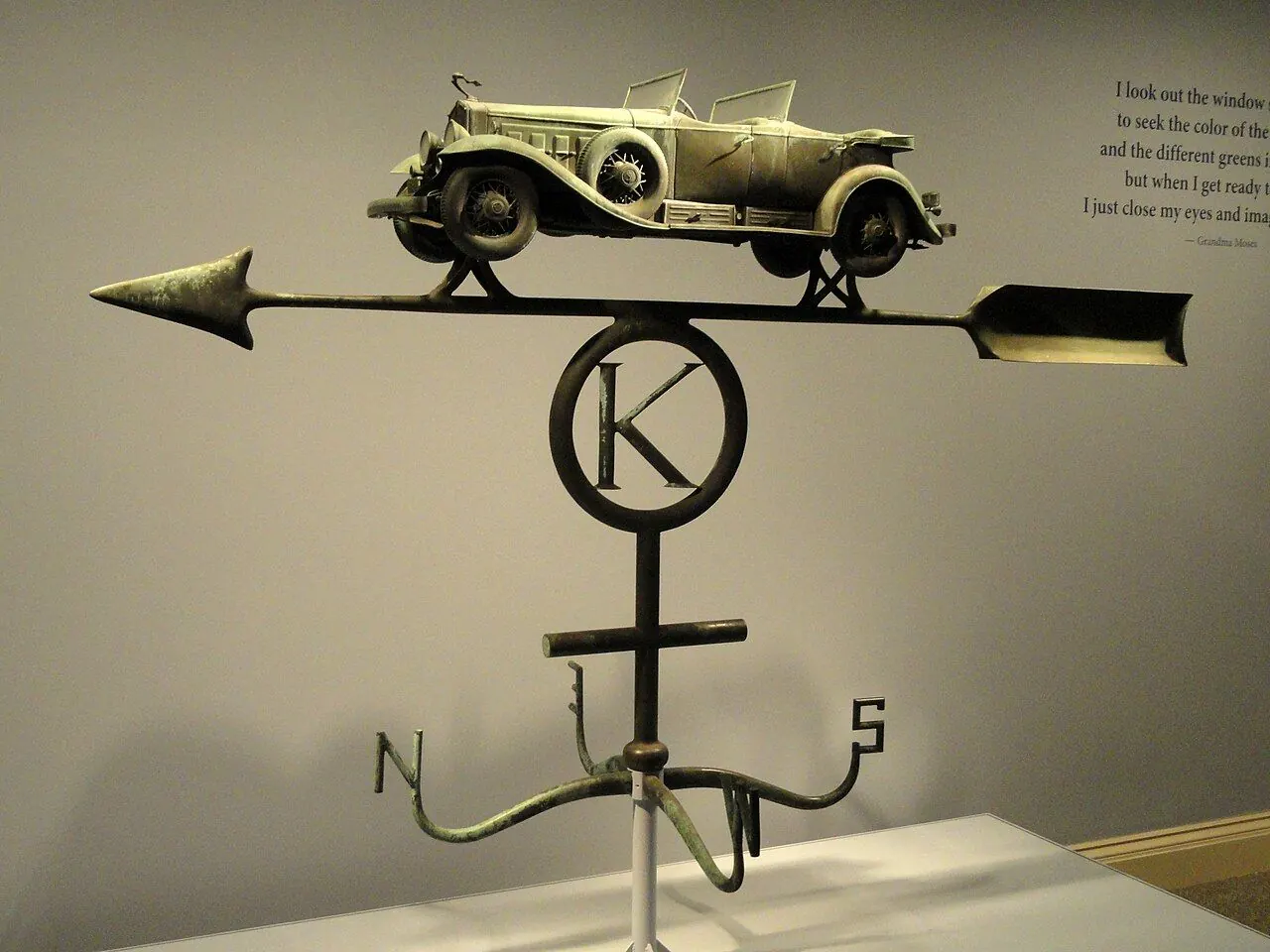
Photo: Daderot / Wikimedia Commons, Public domain. Illustrative image.
Folk art generally points to shared, inherited craft made within a community tradition, while outsider art points to a single self-taught maker's personal, often idiosyncratic vision. Both are broad, overlapping terms for nonacademic art-making, and American museums often show them side by side.
Tradition versus personal vision
Folk art grows out of common, inherited, or communal ways of making without formal art training: quilts, carved decoys, pottery, weathervanes and similar objects whose forms are passed from one maker to the next. Outsider art, and its near-synonyms "visionary," "self-taught" and the French "art brut," usually identifies work centered on personal vision by an artist who learned on their own and works outside the art world. Naive art is a third label, used for painters who lack or set aside academic technique, often with flat perspective and bright color, as in the work of Henri Rousseau or Grandma Moses.
| Label | Core idea | Typical examples |
|---|---|---|
| Folk art | Community tradition, shared and inherited craft | Quilts, decoys, pottery, weathervanes |
| Outsider art | Untrained maker working apart from the art world | Drawings, assemblages, private cosmologies |
| Self-taught art | No academic training; the most neutral museum term | Painting, carving, sculpture of every kind |
| Visionary art | Work arising from an innate personal vision | Art environments, spiritual imagery |
| Naive art | Untrained painting with flat perspective, bright color | Rousseau-style scenes, memory paintings |
Where the labels overlap
Two major US museums show how the categories blur. The Smithsonian American Art Museum keeps folk art and self-taught artists in a single folk and self-taught art collection, which it says "represents the powerful vision of America's untrained and vernacular artists," from quilters and woodcarvers to figures such as Bill Traylor, Martín Ramírez and Howard Finster.
The American Folk Art Museum in New York also collects both. Its exhibition Self-Made: A Century of Inventing Artists takes a critical look at how the "self-taught artist" has been defined in the United States since the early twentieth century, and its collection includes self-taught artists such as Horace Pippin, Sister Gertrude Morgan, Bill Traylor and Elijah Pierce alongside traditional folk objects.
The American Visionary Art Museum in Baltimore defines visionary art as work by self-taught individuals, usually without formal training, "whose works arise from an innate personal vision that revels foremost in the creative act itself." The National Endowment for the Arts notes that visionary art goes by many names, including self-taught art, outsider art and art brut.
How to tell them apart
In practice, museums and dealers use the words loosely, and one artist may be called folk, self-taught and outsider in the same catalog. Many museums, including the Smithsonian and the American Folk Art Museum, favor "self-taught" as the more neutral term, while "outsider" is criticized by some for setting artists apart.
The useful question is where the object comes from: did this quilt come from a local heritage of making and meaning, or did a single maker invent a form no one taught them? The first points to folk art; the second to outsider, self-taught or visionary art. The context the museum or dealer gives will usually settle the rest.