Visionary Art Environments
Five self-built worlds from California to Georgia, what they are, who keeps them standing, and why a quick check before driving saves a wasted trip.
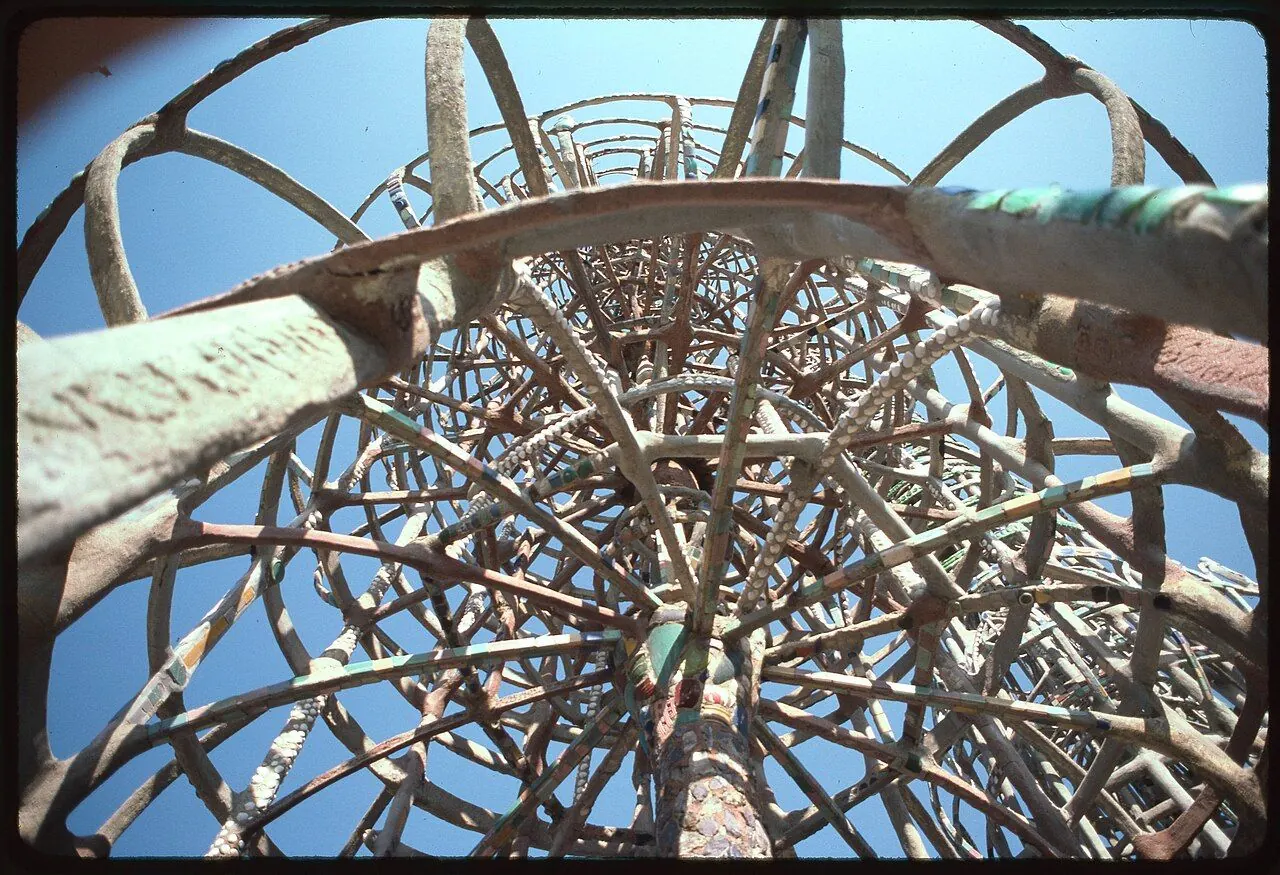
Photo: André Corboz / Wikimedia Commons, CC BY-SA 4.0. Illustrative image.
The best-documented visionary art environments to put on a US road trip include the Watts Towers in Los Angeles, Salvation Mountain in California, the Garden of Eden in Lucas, Kansas, and Paradise Garden and Pasaquan in Georgia. Each has a different caretaker and its own visiting rules, so check the official site before you drive.
What counts as a visionary art environment
Visionary art environments are self-built, large-scale places made by one person, usually self-taught, who transformed a home, yard or hillside for expressive or spiritual reasons. Because their scale and site-specific nature mean they cannot be moved into an ordinary museum, they are seen where they were made, most of them outdoors.
Who keeps them alive
For decades, the Kohler Foundation of Wisconsin has been a major force in preserving these places. According to the foundation, the preservation of folk architecture and art environments has been a major focus since the late 1970s. After a site is acquired and conserved, the foundation gifts it to a museum, municipality, university or other nonprofit for ongoing care. Its related institution, the John Michael Kohler Arts Center in Sheboygan, opened the Art Preserve in 2021 as a museum devoted to artist-built environments.
Other sites are cared for by the counties, cities and volunteer groups around them. Stewardship matters because these works are fragile: paint fades, concrete cracks and found materials rust once the builder is gone.
Five stops for a road trip
| Environment | Where | Built by | Who cares for it |
|---|---|---|---|
| Watts Towers | Los Angeles, California | Simon Rodia, 1921–1954 | Watts Towers Arts Center, City of Los Angeles |
| Salvation Mountain | Near Niland, California | Leonard Knight, from 1985 | Salvation Mountain Inc., a volunteer nonprofit |
| Garden of Eden | Lucas, Kansas | S.P. Dinsmoor, from 1907 | Friends of S.P. Dinsmoor's Garden of Eden, after Kohler Foundation conservation |
| Paradise Garden | Summerville, Georgia | Howard Finster, from the early 1960s | Paradise Garden Foundation |
| Pasaquan | Near Buena Vista, Georgia | Eddie Owens Martin (St. EOM), from the 1950s | Columbus State University, after Kohler Foundation restoration |
The Watts Towers are 17 interconnected sculptural towers and structures that Simon Rodia, an Italian immigrant tile mason, built alone over 33 years from steel, mortar, broken tile, shells and glass. Salvation Mountain is a painted adobe hillside of Biblical messages in the desert of Imperial County. The Garden of Eden surrounds Dinsmoor's limestone "log" cabin with about 150 concrete sculptures. Paradise Garden is Finster's scrap-built "Memorial to God," and Pasaquan covers seven acres with painted temples, walls and totem faces.
Many of these places have limited days, seasonal closures or guided-tour rules, and some are outdoor-only. At the time of writing, for example, Salvation Mountain is open from sunrise to sunset with free entry and a donation box, while Pasaquan opens only Friday through Sunday and closes in December and July. Before any visit, check opening days, tour format and fees on the site's official page; the rules exist both for your safety and for the preservation of the artist's vision.