Sacred Harp Singing Explained
Four shapes, four parts and a square of chairs: the old Southern way of singing that anyone can walk into and join.
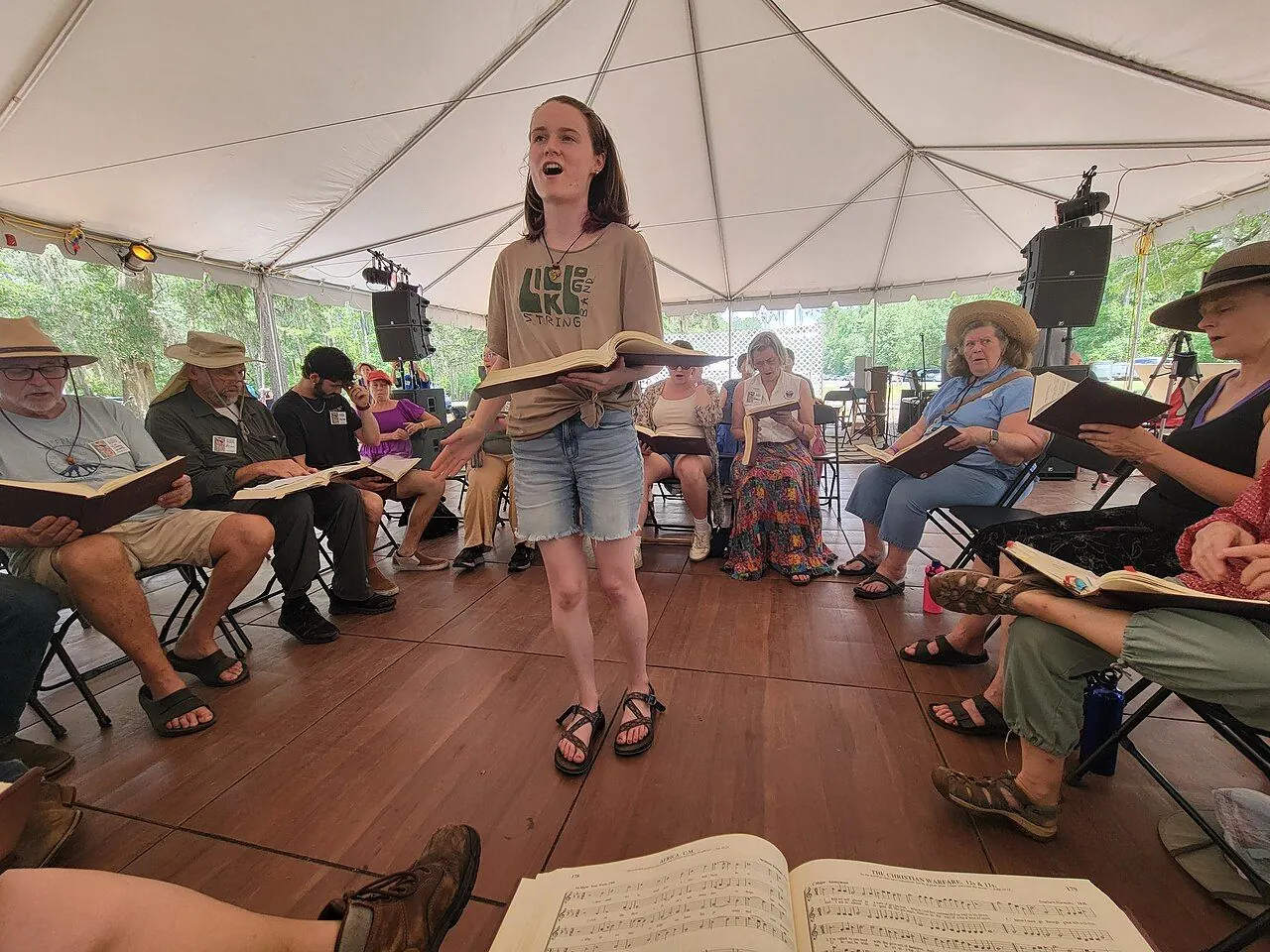
Photo: Esmoell / Wikimedia Commons, CC BY 4.0. Illustrative image.
Sacred Harp singing is a form of communal, unaccompanied sacred music that emphasizes participation, not performance. Singers sit in a hollow square, facing each other, and sing in four parts from shape notes printed in The Sacred Harp, a tunebook first published in 1844.
The tunebook and the shapes
The Sacred Harp was first published in 1844 by B. F. White and E. J. King of western Georgia, and it became the best-known shape-note tunebook in the South. The book is revised only about once a generation. The 1991 Denson revision was the standard edition for decades, and the Sacred Harp Publishing Company issued The Sacred Harp: 2025 Edition, the first new edition in thirty-five years, with 590 songs. Another version, the Cooper revision, is used in parts of the South.
In shape-note notation, each note's shape tells the singer which syllable to sing. Sacred Harp uses four: a triangle for fa, a circle or oval for sol, a rectangle for la, and a diamond for mi. The system was made for singing schools, so people without musical training could learn to read harmony. At a singing, each song is usually sung through first on the syllables, then with the words. This is less important in practice than joining and picking up the rhythm.
How the square works
The traditional seating arrangement is a hollow square facing in, so the sound is focused toward the center rather than out to an audience. Each side holds one of the four parts: treble, alto, tenor and bass. The tenor carries the melody, and both the treble and tenor parts are commonly sung by men and women together.
In the center stands the leader, who picks a song, gives the pitch and beats time with up-and-down strokes of the arm. Leading rotates: singers take turns stepping into the square to lead a song or two. An all-day singing can run through dozens of songs, with a midday meal shared by everyone.
How a newcomer can join
Beginners are welcome, and nobody has to read music fluently. Most singings have loaner tunebooks. Sit with the part that suits your voice, near experienced singers, and follow the leader's beat; if the shapes or syllables are unfamiliar, simply follow the time and sing the words. Listeners are welcome too, but the tradition is built for singers, not an audience.
Singings are held across the South and well beyond it, from local monthly gatherings to multi-day conventions, and there are regular singings in Canada, Europe and Australia. The community keeps schedules and minutes online; the singing directory at fasola.org and the Sacred Harp Publishing Company site at sacredharp.com are good places to find one nearby. Dates change, so check the listing before you go.
The practical takeaway: the only thing standing between you and the hollow square is showing up, taking a book, and singing along.