How Cigar Box Guitars Work
A box, a stick and three strings: the homemade instrument that grew from a make-do folk tool into a worldwide makers' movement.
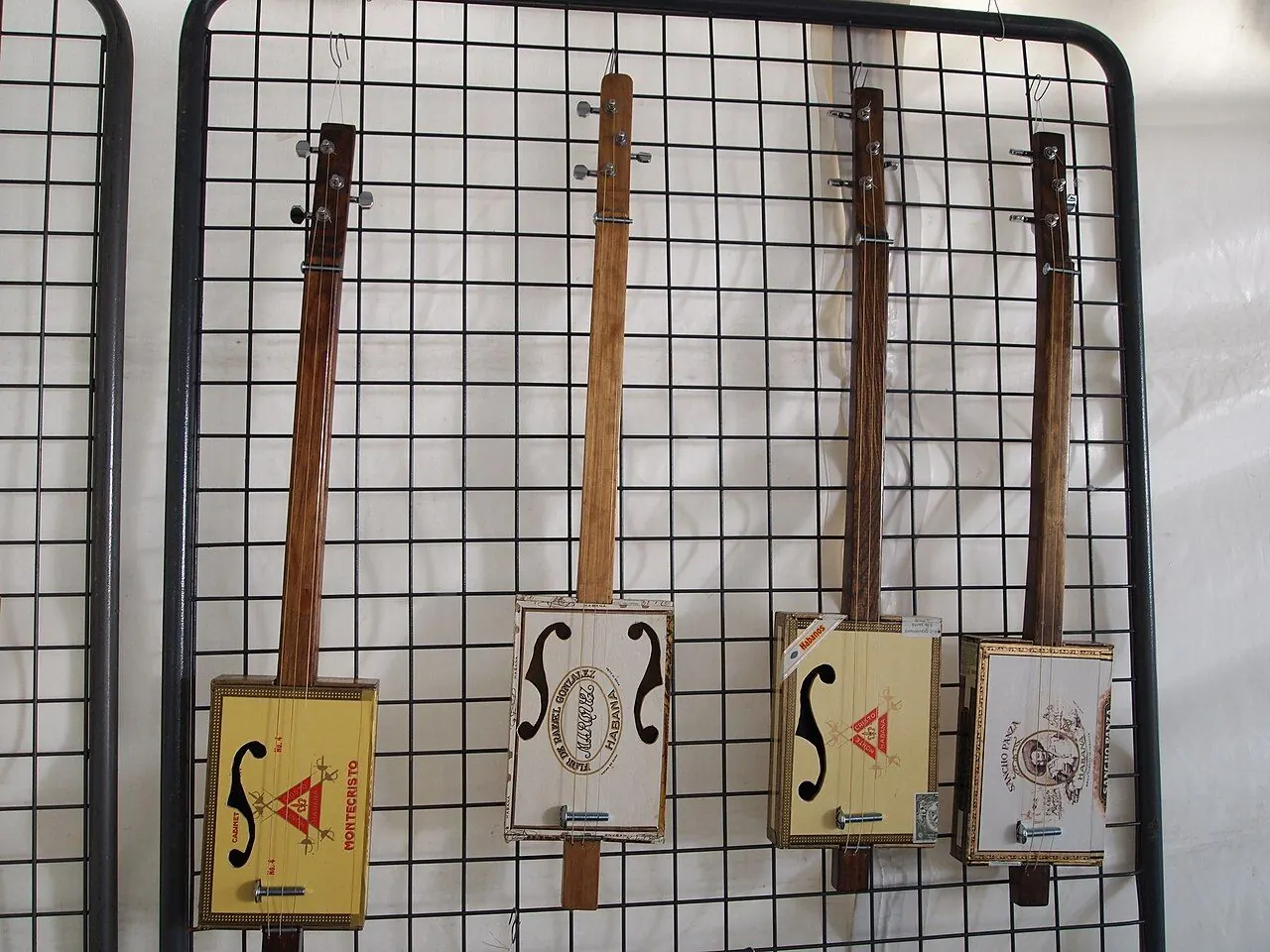
Photo: Rosier / Wikimedia Commons, CC BY-SA 3.0. Illustrative image.
A cigar box guitar is a homemade stringed instrument: a cigar box serves as the body, a straight stick runs through it as the neck, and three strings, usually tuned to open G and played with a slide, stretch between the two. It came out of improvised materials in the nineteenth century, and it stays popular because it is so easy to build.
Homemade roots
Cigar box instruments have been played since at least the mid-1800s. The Smithsonian's National Museum of American History holds a cigar box guitar made by an unknown maker in North Carolina between 1875 and 1899, built from a Morris & Son cigar box. In 1884 Daniel Carter Beard, later a founder of the Boy Scouts of America, published plans for a cigar box banjo in "Christmas Eve With Uncle Enos," and people copied it with simple tools and scraps. Early designs were often just one or two strings attached to the ends of a broomstick pushed through a box.
Over time, its use evolved. A 2021 study in the Journal of Design History traces the instrument from a necessity made by poor families to accompany folk songs, to a simple DIY project associated mostly with children. In the 1990s it was reimagined as a serious, often electrified instrument, and a worldwide community of makers and players grew around it.
Parts and a simple build
Essentially, this instrument is a cigar box with a neck running through it, and strings connecting the two. The parts are few: the box body, a hardwood neck, a nut at the headstock end and a bridge on the lid to lift the strings, a tailpiece to anchor them, three tuners, and three steel guitar strings. Many builds are fretless, which suits slide playing.
- Cut a hardwood neck (maple or oak works well) and thin the headstock so the tuners fit.
- Cut a slot through both ends of the box so the neck passes through and sits flush with the lid.
- Fix a tailpiece, such as a small hinge drilled with string holes, at the tail end.
- Drill pilot holes and mount the tuners on the headstock.
- Set a nut and bridge (a piece of threaded rod is a common choice) and cut one or more sound holes in the lid.
- String up and tune. The usual tuning is open G, G–D–G from the thickest string to the thinnest.
The basic tools are a saw, a drill with bits, screwdrivers, files and sandpaper, with clamps and chisels helpful. Wear eye protection, clamp workpieces before cutting or drilling, and pre-drill screw holes in hardwood so the wood does not split. Remember, over-tensioning guitar strings risks them snapping; if you tune a string up, keep your face well away from it.
Tune from the thickest string to the thinnest to balance tension, then stretch the strings gently and retune two or three times until they hold pitch. To check intonation, compare the open middle string with the note at the 12th position: if the fretted note is sharp, move the bridge back; if flat, move it forward.
How players use it
Open G means the open strings already sound a chord, so a beginner can play a full chord by laying a slide or a barred finger straight across the neck. On a fretless neck, marks at the 5th, 7th and 12th positions give the slide hand its most common targets. Other three-string tunings, such as open D (D–A–D) or open A (A–E–A), change the key and color without any new technique.
The practical takeaway: a first cigar box guitar is an afternoon's project with a few hand tools, and a steady, safe build and stable tuning matter more than a perfect finish.