Southern Face Jugs Explained
From unrecorded Edgefield potters to the Meaders family and Burlon Craig, what a face jug is and why a real antique is so rare.
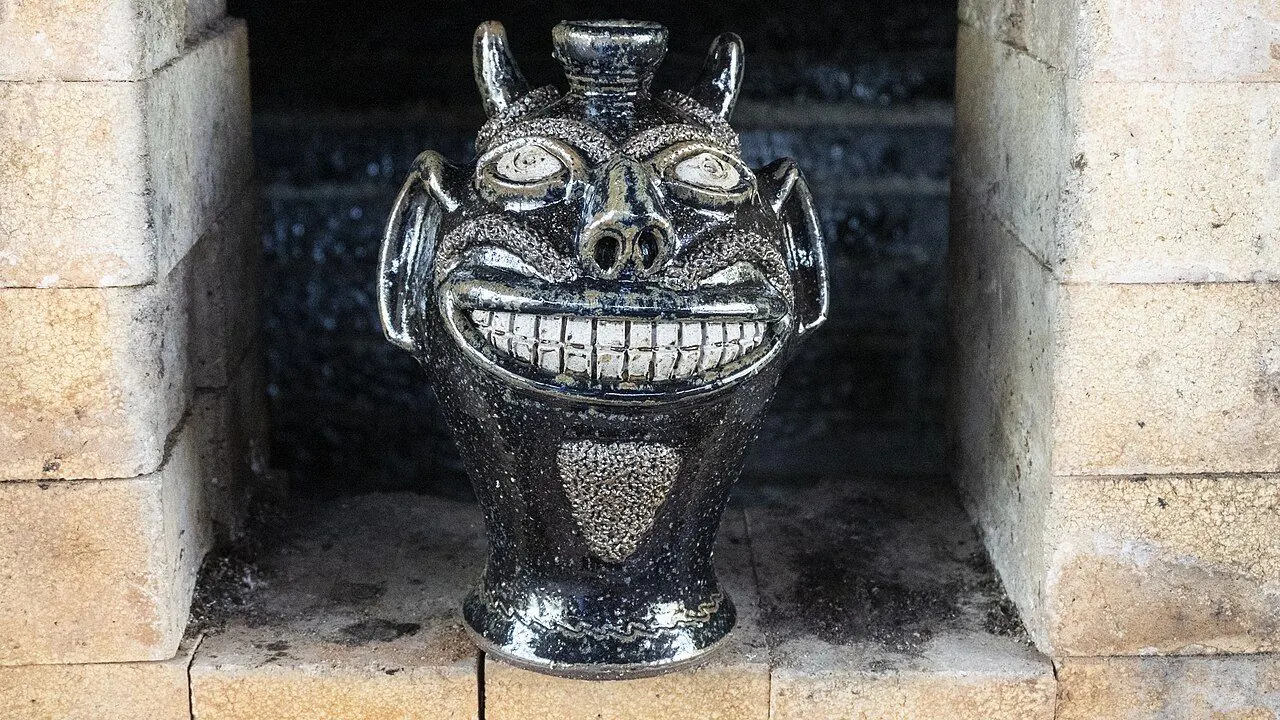
Photo: Folkart2000 / Wikimedia Commons, CC BY-SA 4.0. Illustrative image.
Face jugs are stoneware vessels with a human face built onto the body, and the earliest known examples were made by enslaved and later free Black potters in the Edgefield District of South Carolina in the nineteenth century. Those originals are rare and mostly in museums; most face jugs on the market today are later Southern pottery or modern pieces.
Edgefield origins
The Edgefield District of South Carolina, a center of stoneware production before the Civil War, is the known birthplace of face jugs. The Milwaukee Art Museum says Edgefield face jugs were made by enslaved and later free African Americans from about 1860 to about 1880, when production suddenly stopped. The exhibition "Hear Me Now: The Black Potters of Old Edgefield, South Carolina," shown at the Metropolitan Museum of Art and the Museum of Fine Arts, Boston, presented the face vessels as the work of unrecorded makers.
David Drake, known as Dave the Potter, is the best-known Edgefield name, but he is known for monumental storage jars that he signed, dated and inscribed with verses at a time when literacy among enslaved people was criminalized. Museum records do not tie him to specific face jugs, so a face jug "by Dave" should be treated with deep suspicion.
What makes a face jug
The body is alkaline-glazed stoneware, and the eyes and teeth are made of kaolin, a white clay that stands out sharply against the dark glaze. Museum records use both "face jug" and "face vessel" for the form.
Their original purpose is still a matter of theory rather than fact. The Baltimore Museum of Art says the vessels were not made for utilitarian purposes or sold, but primarily created by or for enslaved potters for use within the community, and that they may have had spiritual meanings tied to African diasporic traditions that have since been lost. Curators at the Milwaukee Art Museum have linked them to Kongo nkisi, spirit containers, blended with African American conjure practice. Popular claims that they guarded graves or scared children away from liquor are lore, not documented history.
Georgia, North Carolina and later makers
The Milwaukee Art Museum notes that white potters took up the form in the 1880s. In north Georgia, the Meaders family pottery at Mossy Creek became closely identified with it: the New Georgia Encyclopedia credits Lanier Meaders (1917–98) with reviving jugs with applied faces after he took over the family shop in 1967, and he received a National Heritage Fellowship from the National Endowment for the Arts. Gillsville families such as the Hewells and Fergusons also kept alkaline-glazed stoneware going. In North Carolina's Catawba Valley, Burlon Craig of Vale made face jugs alongside his swirl ware and received a National Heritage Fellowship in 1984.
For buyers, the practical rule is simple. A Baltimore Museum of Art estimate puts the number of old Edgefield face jugs at only about 200, so a genuine one almost never turns up at a flea market. A signed or marked jug points to a later, named potter, which can be collectible in its own right, while an unmarked "antique" face jug needs documented provenance and an expert opinion before any serious money changes hands.