Quilts of Gee's Bend
How Black women in a bend of the Alabama River turned worn-out clothing into some of the most admired art made in America.
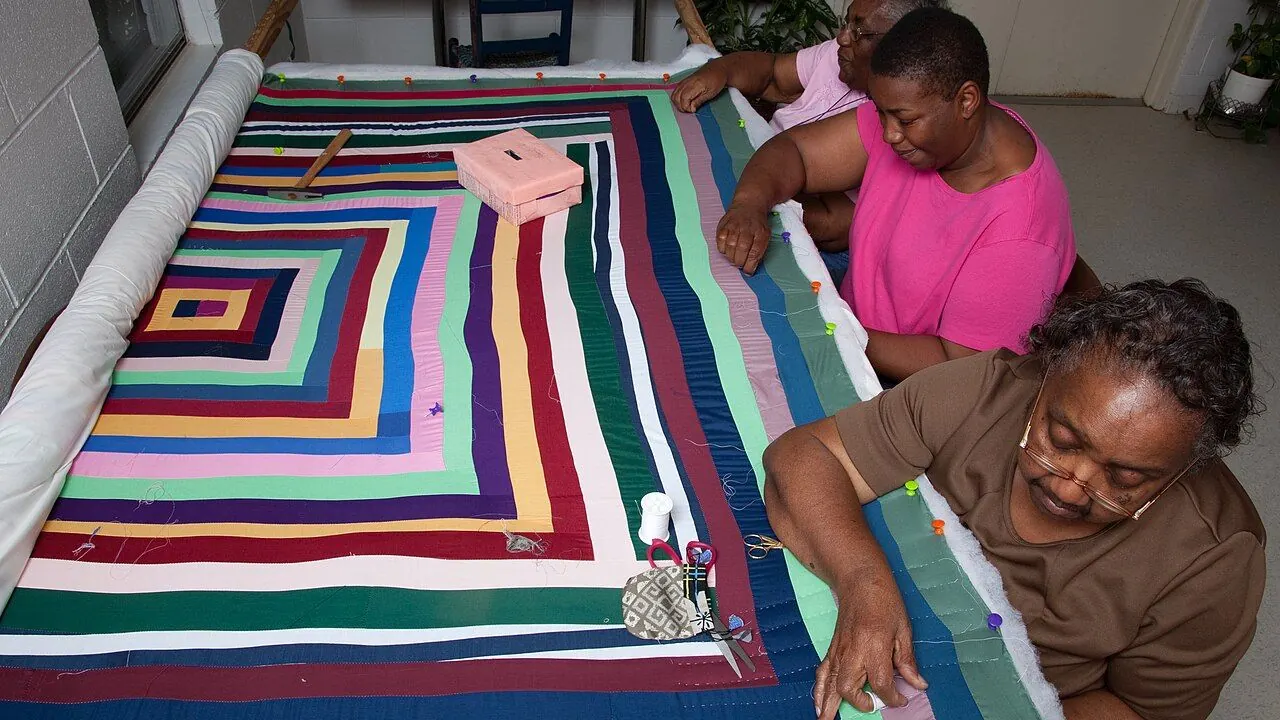
Photo: Carol M. Highsmith via Library of Congress, Commons / Wikimedia Commons, CC0. Illustrative image.
The Gee's Bend quilts are bold, improvised quilts made by generations of Black women in Gee's Bend, Alabama, and they matter because a rural tradition of reusing old clothes produced some of the most celebrated works of American art. They are not museum art from long ago: the quilts are still sewn, sold and taught in the community today.
A tradition born from scraps
The community of Gee's Bend, known officially since 1949 as the town of Boykin, sits in a bend of the Alabama River in Wilcox County, in the west Alabama Black Belt. According to the Souls Grown Deep Foundation, the quilts were made out of old work clothes and other used materials such as fertilizer and flour sacks. These scraps became a canvas for the quilters' designs, so works that catch the eye in a museum first began their lives as castoffs.
Working with whatever cloth was at hand produced lively improvisations and geometric abstraction rather than fixed patterns copied from a book, and the skills passed from generation to generation. That is what made the quilts stand out to art insiders for their originality and boldness, and why critics began to compare them with modern painting.
The 2002 exhibition and the museums
The quilts of Gee's Bend first came to national attention through a landmark exhibition. "The Quilts of Gee's Bend" opened at the Museum of Fine Arts, Houston, in 2002 with more than 70 quilts by 45 quilters, according to the Encyclopedia of Alabama, then traveled to the Whitney Museum of American Art in New York and other museums across the country until 2006.
In 2006 the US Postal Service issued "Quilts of Gee's Bend" commemorative stamps with ten designs, the sixth set in its American Treasures series. Quilts from Gee's Bend have since entered major collections, including the Metropolitan Museum of Art, the National Gallery of Art and the Smithsonian American Art Museum. Yet the quilts and their making remain tightly connected to the women of Gee's Bend.
The cooperatives and how to buy
The Freedom Quilting Bee, a cooperative founded in 1966 by African American women in neighboring Rehoboth, near Alberta, gave local quilters a way to turn handicraft into income during the civil rights era, and some Gee's Bend quilters worked with it. In 2003 the quilters established their own Gee's Bend Quilters Collective in Boykin to market and sell their work.
For those interested in seeing or buying the quilts, the community's official site, geesbend.org, is the best starting point. It is a project of the Souls Grown Deep Foundation and the communities of Gee's Bend and Alberta, and it points to quilts sold by the makers themselves, to the Welcome Center in Gee's Bend and to hands-on quilting workshops with local makers. Prices, visiting hours and workshop schedules change, so check the site before you travel or buy. Buying through these channels is the simplest way to be sure a quilt is authentic and that the money reaches the quilters.